

Rechargeable batteries quietly run a huge slice of daily life, from TV remotes and game controllers to cordless drills and electric scooters. The catch is that not every charger treats those cells the same way, and the wrong match can shorten battery life or leave you waiting around for hours. This guide walks through nine chargers for rechargeable batteries that cover household, workshop, and specialty use cases, so you can match the right hardware to the batteries you actually own.
The Leading Options At A Glance

Eneloop Panasonic K-KJ55MCA4BA 3-Hour Quick Charger with 4 AA Batteries

eeTao 42V Charger for WERHY H5 H7 Electric 36V Battery

DeWALT DCB107 12V/20V MAX Lithium Ion Charger

Eneloop Panasonic K-KJ55MC84CZ Power Pack 8AA, 4AAA, 3-Hour Quick Charger

Ostation 2 Pro AA AAA Charging Station with 24 Batteries
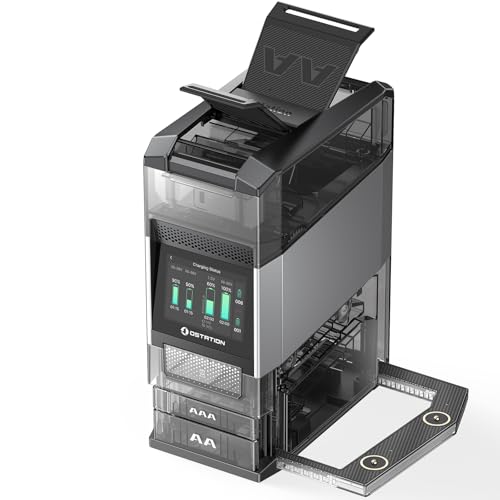
Ostation 2 Pro AA AAA Charging Station for NiMH and Lithium

Ostation 2 Smart AA AAA Charging Station with Polarity-Free Detection

Eneloop Panasonic CC55KSBHA Pro Charger with AA and AAA High-Capacity Cells

Streamlight 75105 Smart Charger Holder for Stinger Flashlights
Inside Each Recommended Option
The Eneloop K-KJ55MCA4BA is the kind of kit that quietly disappears into a junk drawer and just works, year after year. It bundles a four-bay charger with four AA NiMH (nickel-metal hydride) cells, so a household that runs through remote and clock batteries can stop buying disposables the same day it arrives.
Charging tops out around three hours per cycle, which is quick enough for overnight top-ups but not the fastest on this list. Compared to the larger Eneloop power pack reviewed later, this one stays small and unobtrusive on a kitchen counter.
The Value In It
- Four AA cells included, so first-time users skip a separate battery purchase.
- Individual charging channels help extend cell life by avoiding overcharge on already-full batteries.
- Compact plug-in design fits behind furniture where bulkier chargers would not.
- NiMH chemistry holds charge for months, ideal for low-drain devices like remotes.
Points To Note
- Three-hour charge time may feel slow for heavy daily rotation across many devices.
- Includes AA cells only, so AAA buyers will need to source those separately.
- No LCD screen, so charging status is communicated by simple indicator lights.
Whose Shelf It Belongs On
Casual households running remotes, wall clocks, and small toys that need a steady, low-maintenance supply of AA power.
Where Another Pick Suits Better
Shoppers who want both AA and AAA cells in one box should consider the Eneloop K-KJ55MC84CZ power pack instead.
This eeTao unit is a specialty replacement power supply, not a household AA charger, so it earns its spot for a specific reason. It targets owners of WERHY H5 or H7 personal mobility batteries who need a spare or replacement 42V brick.
Worldwide input voltage (100 to 240 VAC at 50/60 Hz) means it travels well for riders who move between regions. It is a niche pick compared to the Eneloop kits above, so most shoppers will want to keep scrolling unless this matches their exact gear.
A Favorable Mix
- Built-in over-voltage, over-current, and short-circuit protection add a layer of safety during long charges.
- Broad input voltage range supports use in different countries without a separate converter.
- Direct replacement design avoids the hassle of adapters or third-party cables.
Where It May Fall Short
- Limited to specific WERHY H5 and H7 packs, with no use for other brand batteries.
- No status display, so charge progress is hard to gauge at a glance.
Built With In Mind
Owners of compatible WERHY H5 or H7 electric mobility batteries who need a dedicated replacement or travel charger.
Reach For A Different Pick When
Anyone charging AA or AAA household cells should look at the Eneloop K-KJ55MCA4BA quick charger instead.
The DeWALT DCB107 is built for tradespeople who cycle packs through a drill or impact driver all day. It accepts both 12V and 20V MAX lithium-ion slide packs, which covers a wide slice of the brand’s cordless lineup.
An LED indicator on the front communicates charge status, hot or cold pack conditions, and end-of-life warnings, so the user does not have to guess what is going on. It runs on standard 120V household current, so it slots into a shop or garage without rewiring.
Reasons It Performs
- Charges a depleted pack in roughly an hour or less, keeping job-site downtime manageable.
- Cross-platform support for both 12V and 20V MAX packs simplifies a mixed tool fleet.
- Diagnostic LED catches a failing pack before it strands you mid-task.
Honest Caveats
- Only fits DeWALT 12V and 20V MAX packs, so other brands are out of luck.
- Lacks a fan-cooled multi-port design found on faster DeWALT chargers.
Best Suited To
Tradespeople and serious DIYers running a DeWALT 12V or 20V MAX cordless tool system on a busy workday.
A Better Fit Elsewhere
Households that only need AA or AAA charging should look at the Ostation 2 Smart charging station for a friendlier fit.
The K-KJ55MC84CZ power pack stretches the Eneloop formula into a fuller household starter kit. It includes eight AA cells, four AAA cells, and the same 3-hour quick charger found in the smaller kit, so a new user gets a generous spread right out of the box.
Eneloop AA cells in this bundle are rated around 2000 mAh typical, with AAA cells near 800 mAh, which is a useful real-world capacity for TV remotes, game controllers, and small toys. The trade-off is a chunkier box and a higher entry cost than the four-AA kit reviewed first.
Real-World Strengths
- Twelve bundled cells cover most household devices from day one.
- Mix of AA and AAA sizes reduces the need for extra shopping trips.
- Cells are pre-charged and ready to use straight from the package.
- Recharge cycle rating stretches into the thousands, lowering long-term cost.
Practical Considerations
- Higher upfront cost than the smaller four-AA starter bundle.
- Three-hour charge time still feels slow if you rotate packs constantly.
Key Specs
Made For
Busy family households juggling a mix of AA and AAA devices that want a one-box solution to get started.
Not Your Match When
Shoppers who need faster turnaround should consider the Ostation 2 Smart charging station reviewed further down.
The Ostation 2 Pro is a different shape of product entirely, more like a small appliance than a charger. It combines a charging station, battery tester, and organizer in one unit that can hold up to 24 cells, plus dual magnetic ports for compatible Olight flashlights.
Smart sorting routes each cell into the right state, and thermal-adaptive charging adjusts current based on heat. It is a clear step up from the Eneloop kits if your household burns through AA and AAA cells every week.
What Pays Off
- Hands-free drop-in design removes the fiddly slot-by-slot loading of traditional chargers.
- 24-battery capacity keeps a serious stockpile ready at any time.
- Built-in tester and organizer cut clutter from drawers and bins.
- Dual MCC magnetic ports double as a dock for compatible flashlights.
Smaller Limitations
- Larger footprint demands a dedicated counter or shelf space.
- Learning curve is steeper than a simple plug-in charger.
Right Fit For
Large households, photography studios, or anyone who treats batteries as a constant consumable rather than an occasional purchase.
Look Elsewhere When
Casual users with only a handful of devices will be happier with the simpler Eneloop K-KJ55MCA4BA starter kit.
This Ostation 2 Pro variant is the same charging station without the bundled cell pack, aimed at owners who already have a stockpile of NiMH or lithium AA and AAA batteries. It accepts both chemistries, which adds real flexibility compared to chargers locked to one cell type.
Smart sorting, thermal-adaptive charging, and real-time monitoring carry over from the bundle version. If you already invested in quality cells, paying only for the station feels like the smarter move.
Good Reasons To Consider
- NiMH and 1.5V lithium compatibility covers most modern rechargeable formats.
- Up to 24-cell capacity keeps both charged and spares organized in one place.
- Hands-free loading means less fiddling per session.
Trade-Offs To Consider
- No cells included, so first-time users face an extra purchase step.
- Counter footprint is larger than a basic plug charger.
Perfect Match For
Existing rechargeable battery owners who want to upgrade from a basic plug charger to a smarter, more organized station.
Skip It When
First-time buyers will save a step by going with the Ostation 2 Pro bundle reviewed above.
The Ostation 2 Smart takes the station concept and leans into convenience. Polarity-free detection means a dropped-in cell goes in either direction and still charges, which removes a small but real friction point for kids, guests, or anyone loading cells in a hurry.
It supports both NiMH and 1.5V lithium rechargeables, plus Ostation 1.5V lithium cells, making it the most chemistry-flexible pick in this lineup. For gamers and smart-home users with high battery turnover, the hands-free workflow pays off fast.
Real Benefits
- Polarity-free slots remove the guesswork of lining up positive and negative ends.
- Fast charging suits devices that chew through AA cells in a week.
- Auto-detection routes each cell to the correct state without manual sorting.
- Smart-home aesthetic fits more cleanly on a counter than a brick-style charger.
Worth Bearing In Mind
- Premium pricing compared to basic plug-in chargers.
- Needs a stable, flat surface due to its top-loading design.
Quick Facts
Who Will Love This
Gamers, smart-home enthusiasts, and any household that wants batteries handled without thinking about orientation or sorting.
Consider Something Else When
Shoppers on a tighter budget will find the Eneloop K-KJ55MCA4BA four-AA starter covers the basics for less.
This bundle is the pro-grade sibling to the standard Eneloop kit, pairing the CC55 advanced charger with high-capacity pro AA and AAA cells. AA cells in this set are rated around 2500 mAh typical, with AAA cells also bumped up versus the standard line, which matters for high-drain gear.
The CC55 charger individually monitors each slot with its own LED color indicator, so you can see exactly where each cell is in its cycle. Owners of camera flashes, audio gear, and other power-hungry devices will appreciate the extra capacity headroom.
Notable Gains
- Pro AA cells at roughly 2500 mAh typical give longer runtime per charge than standard cells.
- Individual slot monitoring helps prevent overcharge and extends pack life.
- Compatible with both standard eneloop and eneloop pro AA and AAA cells.
Factors To Consider
- Premium pricing compared to standard Eneloop kits.
- Lower recharge cycle rating than the standard line, common with higher-capacity NiMH cells.
Feature Snapshot
Who Should Grab It
Photographers, videographers, and audio techs running flashes, mics, or other high-drain devices on a regular basis.
Swap It Out When
Households that mostly power remotes and clocks will be overpaying here and should look at the Eneloop K-KJ55MC84CZ power pack instead.
The Streamlight 75105 sits in a different lane from the rest of this list, a smart charging cradle for Stinger series flashlights. It mounts to a wall or sits on a surface, and the flashlight drops in to top off its pack without fiddling with cables.
Smart charging technology prevents overcharging, which is helpful for shift workers who leave a light parked in the cradle between calls. Compared to the Ostation 2 Smart reviewed above, it is far more focused: one device, one cradle, one purpose.
A Few Highlights
- Drop-in design keeps a Stinger flashlight topped up and ready at all times.
- Overcharge protection helps extend the life of the flashlight’s internal battery.
- Durable construction suits mobile mounting in vehicles or workstations.
Potential Compromises
- Limited to Streamlight Stinger series flashlights, with no use elsewhere.
- Single-device capacity means charging a fleet requires multiple cradles.
At A Glance
Right Fit For
First responders, security teams, and patrol officers who keep a Stinger flashlight in active service day and night.
Another Choice May Suit
Anyone charging standard household cells should ignore this entry and focus on the Eneloop K-KJ55MCA4BA quick charger instead.
Picking A Charger That Actually Fits Your Batteries
The right charger for rechargeable batteries depends on three questions: what chemistry and size you use, how many cells you cycle per week, and whether you want a basic plug or a smarter station. NiMH remains the most common rechargeable chemistry for AA and AAA sizes, while 1.5V lithium rechargeables are gaining ground in high-drain devices. Matching the charger’s supported chemistries to the cells you own prevents the slow degradation that comes from running the wrong current through a pack.
For most households, a simple 3-hour plug charger with individual channels, like the Eneloop kits reviewed above, is plenty. Frequent users benefit from a charging station with sorting and testing, while tradespeople need a brand-specific charger that matches their cordless tool platform. Specialty gear, from mobility batteries to Stinger flashlights, requires a dedicated cradle or power supply that matches the exact product model.
Capacity ratings tell you how long a cell runs per charge, while recharge cycle counts estimate total lifespan. Higher mAh (milliamp-hours) means more runtime, but often at the cost of fewer total cycles, so balance those two numbers against your real usage pattern. Charging time matters when you cycle packs daily, and slow overnight charging is usually fine for remotes and clocks.
Key Considerations Across These Picks
Where Shoppers Go Wrong
The most common slip-up is grabbing a charger that only handles one chemistry and then buying cells in a different format a year later. The Ostation 2 Smart reviewed above sidesteps this by accepting both NiMH and 1.5V lithium. Another trap is assuming any USB-C cable will work as a replacement, which can deliver the wrong voltage to a tool or mobility battery.
When Paying More Pays Off
Higher-tier stations like the Ostation 2 Pro justify their cost for households that rotate dozens of cells per month, where hands-free sorting and built-in testing save real time. Pro-grade Eneloop cells earn their premium for high-drain gear like camera flashes, where the extra capacity per charge matters more than the slightly lower cycle count. For a household that only charges a handful of remotes each season, a basic plug-in kit delivers everything needed at a friendlier entry point.
Frequently Asked Questions
What is the difference between NiMH and lithium rechargeable AA batteries? NiMH cells are the traditional rechargeable format, typically rated around 2000 to 2500 mAh for AA sizes, and they self-discharge slowly when idle. 1.5V lithium rechargeables hold a higher voltage more consistently under load but require a charger that explicitly supports them, like the Ostation 2 Smart.
How long do rechargeable batteries take to charge? Most plug-in chargers for household cells finish a full charge in 2 to 4 hours, while tool and mobility chargers can be faster or slower depending on pack size. A station like the Ostation 2 Pro adjusts current based on heat and cell type, which can speed up mixed loads.
Can I mix battery brands in the same charger? Most modern chargers accept any brand of NiMH AA or AAA cell, so mixing brands is generally safe as long as the chemistry and size match. Stations like the Ostation 2 Pro explicitly support any-brand NiMH cells, which makes rotation across brands easier.
Do I need to fully drain rechargeable batteries before recharging? Modern NiMH and lithium cells do not have a memory effect like older chemistries, so topping them off early is fine. Running them fully to zero on a regular basis can actually shorten overall lifespan for most current cell types.
How do I know when a rechargeable battery needs replacing? A built-in tester, like the one inside the Ostation 2 Pro and Smart stations, flags cells that no longer hold a full charge. Common signs in everyday use include devices dying much sooner than expected or chargers reporting a problem on a specific slot.
The Takeaway
The best charger for rechargeable batteries is the one that matches your chemistry, your cell count, and the patience you have for charging cycles. Households with a handful of remotes will be happy with a simple Eneloop kit, while busy homes and gamers benefit from a hands-free station. Match the charger to the cells you already own, and the rest takes care of itself.


