

Cutting the cable between your guitar and amp can feel like an instant stage upgrade, especially if you’re tired of tripping over cords at home gigs or dragging a long cable across a rehearsal room. Cheap wireless guitar systems have come a long way from the hiss-prone, drop-out-prone toys of the past. Many modern units now deliver latency low enough for live playing and audio quality that holds its own against a decent patch cable. The eight systems below cover a wide spread of use cases, from quick living-room practice rigs to pedalboard-friendly setups for small club dates.
An Overview Of The Picks

Xvive AC58 Wireless Guitar System with Charging Case

Xvive AC58 Wireless System Vintage Sunburst with BCA58 Charging Case

Shure GLXD14 Digital Wireless Guitar System
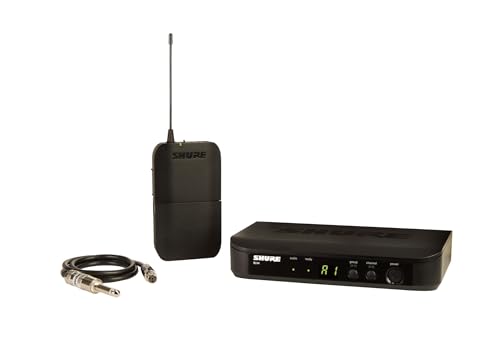
Shure BLX14 Wireless Guitar System H10 Band

Umelody WS-MINI2 Wireless Guitar System 2.4GHz

Shure GLXD16 Wireless System with GLXD6 Pedal Receiver

XVIVE A58 5.8GHz Wireless Guitar System

Tonebird NUX C-5RC Wireless System with Bundle
The Strengths Of Each Pick
The Xvive AC58 sits at the top of the list because it pairs the brand’s popular A58 wireless tech with a charging case that solves one of the most common complaints about budget wireless rigs: dead batteries mid-set. The 5.8GHz band (a wireless frequency range that tends to be less crowded than 2.4GHz in homes and venues full of Wi-Fi routers) keeps the signal cleaner in apartment buildings and coffee-shop gigs where interference is the usual villain.
For the bedroom player who wants to wander to the couch while jamming along to a backing track, or the weekend warrior who plays three short sets at the local bar, this combination hits a sweet spot. Compared to the bare-bones XVIVE A58 covered later in this list, you get the convenience of drop-in charging without paying a huge premium.
Why It Works Well
- Bundled charging case adds real-world convenience and removes the need to remember to plug in each piece.
- 5.8GHz operation avoids much of the congestion you’d hit on the older 2.4GHz band.
- Full 20Hz–20kHz frequency response covers the entire audible spectrum so you don’t lose bass warmth or high-end shimmer.
- Under 5ms latency (the tiny delay between playing a note and hearing it through the amp) is more than fast enough for live playing.
- True diversity reception uses two antennas internally to pick the stronger signal, which helps reduce dropouts.
Worth Bearing In Mind
- Range claims vary in real-world settings, and you’ll want to keep line-of-sight to the receiver for the steadiest signal.
- Charging case only helps if you actually dock the units after each session, so a routine matters.
Key Product Details
Made For
Guitarists who play small gigs, rehearsal spaces, or want clean home recording without cable clutter.
Look Elsewhere When
The Shure GLXD16 is the better match if your setup lives on a pedalboard and you want a stompbox-format receiver instead of a tabletop unit.
If you like your gear to look as good as it plays, this Vintage Sunburst version of the AC58 keeps the same internals as the standard model but adds a finish that feels at home next to a relic’d Strat or a worn Les Paul. The BCA58 charging case provides up to two full charges or multiple top-ups, which matters on tour runs where outlets are scarce.
Under the hood, you get the same 5.8GHz true diversity system (two antennas that automatically pick the cleaner signal) and 24-bit/48kHz audio handling as the plain AC58 reviewed above. The honest read is that you’re paying a small premium for style, not new tech, which is exactly right for players who care about pedalboard photos and stage presence.
Notable Gains
- Vintage Sunburst finish pairs well with classic-styled guitars and amps.
- Same proven 5.8GHz wireless platform as the standard AC58, so no surprises on tone.
- Charging case offers two full recharges for longer sessions away from outlets.
- Compatible with active and passive pickups, so you can swap instruments freely.
Practical Considerations
- Internals match the cheaper AC58, so the price difference is purely cosmetic and bundled extras.
- The colored finish shows scratches more easily than plain black plastic if you toss the unit in a gig bag.
- For purely functional buyers, the basic XVIVE A58 later in this list covers the same wireless job.
Built With In Mind
Style-minded guitarists who want their wireless rig to match their vintage-styled axes and value having a charging case on hand.
Consider Something Else When
The Umelody WS-MINI2 makes more sense if you need a 2.4GHz setup with a 130ft range for larger stages.
The Shure GLXD14 is the system you’d expect to find in the rack of a working club guitarist who can’t afford dropouts during a paid set. LINKFREQ Automatic Frequency Management is Shure’s term for a system that constantly scans the airwaves and jumps to a clean frequency the moment interference appears, without you lifting a finger.
The GLXD4 tabletop receiver pairs with a GLXD1 bodypack transmitter and a WA302 instrument cable ready to plug into your guitar’s output jack. Compared to the Xvive units covered earlier, this is a step up in build quality and stage-ready confidence, though it also costs more. Lithium-ion rechargeability means swapping disposable batteries is a thing of the past.
A Favorable Mix
- LINKFREQ Automatic Frequency Management reroutes around interference without interrupting audio.
- Lithium-ion rechargeable batteries cut long-term cost and waste versus disposables.
- Shure’s reputation for build quality means the bodypack and receiver handle the road.
- WA302 instrument cable included so you can plug straight in out of the box.
Some Limits To Know
- Costs noticeably more than the Xvive and Umelody picks earlier in this list.
- 2.4GHz operation can get crowded in dense Wi-Fi environments like apartment buildings.
- The bodypack form factor requires you to clip the transmitter to your belt or strap, which adds a small step to setup.
Right Fit For
Working musicians playing small to mid-size venues who need drop-out-free performance and the reliability of a major pro-gen audio.
Swap It Out When
The Shure BLX14 is worth a look if you’re on a tighter budget and only need the basics for a small venue or rehearsal space.
The Shure BLX14 is the entry point into the brand’s analog wireless ecosystem, and it earns its place by being one of the simplest setups to walk into a venue with and use. The H10 band operates in the 542–572 MHz range, which is worth checking against local TV broadcast allocations before you commit, since analog wireless rules are stricter than digital systems in some regions.
For a worship band leader, a Sunday morning coffee, or a small club performer, this is the kind of rig that just works once you set the channel. It runs on AA batteries, so you’ll want to keep spares in the gig bag, but the trade-off is freedom from chargers on stage.
Positive Points
- Trusted Shure build at a more approachable cost than the GLXD-series rigs.
- Simple setup with intuitive controls, good for first-time wireless users.
- AA battery power means you can swap in fresh cells at any gas station or venue.
- Available in multiple frequency bands (H10, H9, H8) for different regions and venues.
Things To Weigh Up
- Analog operation in the UHF band means you must verify local frequency legality before purchasing.
- No rechargeable battery system, so ongoing battery costs add up over time.
- Lacks the auto-frequency-hopping smarts of the LINKFREQ-equipped GLXD14 reviewed above.
Best Suited To
Small venue performers, worship teams, and rehearsal spaces who want a trusted Shure wireless at a more approachable cost.
Reach For A Different Pick When
The Shure GLXD14 is worth the upgrade if automatic frequency management and rechargeable batteries matter for your gigging life.
The Umelody WS-MINI2 stands out in this list for two practical reasons: it claims up to 130 feet of working range, and the transmitter has a rotatable jack that fits guitars, basses, and any 6.35mm-equipped instrument. That matters for keyboard players, drummers triggering pads, or anyone running a hybrid rig where one wireless system gets shared around the band.
It runs on the more common 2.4GHz band, which is the same slice of air most Wi-Fi routers use, so very crowded spaces can occasionally challenge it. For a home studio or a mid-sized rehearsal room, that trade-off usually doesn’t matter, and the plug-and-play setup means you spend less time tinkering with menus.
Well-Handled Touches
- Rotatable jack design fits a wider range of instruments than fixed-angle plugs.
- Claimed 130ft range covers most stage and rehearsal room setups.
- Plug-and-play pairing gets you playing fast without diving into menus.
- Bundled charging case keeps both units topped off between sessions.
- Works with keyboards, drum pads, and other 3.5mm/6.35mm-equipped gear, not just guitars.
Honest Caveats
- 2.4GHz operation is more susceptible to Wi-Fi interference than the 5.8GHz Xvive models earlier.
- Real-world range often falls short of the maximum claim when walls or bodies get in the way.
Who It Suits Best
Multi-instrument players and home producers who want one wireless system that can hop between guitar, bass, and keys.
Where Another Pick Suits Better
The Xvive AC58 is a better fit for guitarists who play in Wi-Fi-heavy venues and need the cleaner 5.8GHz band.
The GLXD16 is the system for players whose entire rig lives on a pedalboard. Instead of a tabletop receiver taking up space behind your amp, you get the GLXD6 digital pedal receiver, which sits in line with your other effects and acts as both a wireless endpoint and a tuner with on-board display. The GLXD1 bodypack transmitter and WA305 instrument cable round out the package.
Compared to the GLXD14 covered earlier, this version trades the tabletop receiver for pedalboard integration. The catch is that you lose the tabletop unit’s dedicated display real estate, so all your status info now lives on the pedal face. That swap works beautifully for clean board setups but feels cramped if your pedalboard is already full.
Notable Upsides
- Pedal-format receiver integrates cleanly into a pedalboard setup.
- Built-in tuner display means one fewer device on your board.
- LINKFREQ Automatic Frequency Management handles interference jumps silently.
- Lithium-ion rechargeability cuts the disposable battery cost over years of use.
- Shure’s standard of build quality carries over from the tabletop GLXD line.
A Few Limitations
- Pedalboard footprint adds to your real estate, so crowded boards may need rearranging.
- Higher cost reflects the dual-purpose design.
- Same 2.4GHz operation as other GLXD units, so dense Wi-Fi venues can still challenge the signal.
Who Will Love This
Pedalboard players who want their wireless rig to look like part of the effects chain instead of an extra box on the amp.
Skip It When
The Shure GLXD14 is the better call if you’d rather keep the receiver off the board and free up pedal space.
The XVIVE A58 is the no-frills version of the AC58 covered earlier in this list. You get the same 5.8GHz wireless platform, the same passive and active pickup compatibility, and the same automatic channel selection that scans for the cleanest signal on power-up. What you don’t get is the bundled charging case, which is exactly why this lives in the budget corner of the lineup.
For a guitarist just stepping into the wireless world who doesn’t want to learn a charging routine on day one, this is the lowest-friction entry point. Owners commonly report the unit ships with a USB-C cable for direct charging, which is convenient if your phone already uses the same standard.
Benefits That Matter
- More accessible cost than the AC58 bundle while keeping the core wireless tech.
- Automatic channel scanning picks the cleanest frequency at power-up.
- Active and passive pickup modes cover a wide range of instruments.
- 5.8GHz operation avoids most Wi-Fi congestion in typical homes and small venues.
Practical Considerations
- No charging case included, so you’ll need a USB cable and outlet to top off.
- Battery indicator is less informative than higher-tier models with full LCD displays.
The Right Fit
First-time wireless buyers who want proven Xvive quality without paying for extras they may not use right away.
A Better Fit Elsewhere
The Xvive AC58 is the smarter pick if you value the bundled charging case and want drop-and-go convenience.
The Tonebird NUX C-5RC is built around NUX’s 5.8GHz wireless platform with auto-match pairing, which means the transmitter and receiver sync up on first power-up with zero menu diving. What makes this listing different from the standard NUX offering is the bundled extras: a charging case, patch cable, polish cloth, and tool bundle.
For a gift-giver shopping for a guitarist who has everything except wireless, the bundle format means the recipient opens one box and has a complete kit ready to plug in. The polish and tools are nice touches, though the core wireless tech is the real value here.
The Value In It
- Bundled extras like patch cable and polish mean a true out-of-box experience.
- Auto-match pairing eliminates manual syncing between transmitter and receiver.
- 5.8GHz operation sidesteps the Wi-Fi interference common on 2.4GHz systems.
- Charging case extends the practical unplugged time between outlet visits.
Things To Consider
- Bundled extras drive up the cost versus a bare-bones NUX purchase elsewhere.
- Polish and tools are consumables that will eventually run out.
Perfect Match For
Gift-givers and first-time wireless users who want a complete, ready-to-go kit without buying accessories separately.
Not Your Match When
The XVIVE A58 is a better fit for budget-focused shoppers who’d rather skip the extras and pay only for the wireless tech.
What To Weigh Before Buying A Cheap Wireless Guitar System
Cheap wireless guitar systems vary more than the sticker might suggest, so the right match depends on how and where you actually play. Latency is the first thing to check: any value under about 10ms feels transparent, and most modern systems advertise well under that. Battery format matters more than it seems, since rechargeable lithium-ion beats disposable AAs over years of use, but AAs let you swap fresh cells at any venue.
Range claims deserve healthy skepticism. A “100ft” rating often translates to 30–50ft in a real room full of bodies, walls, and Wi-Fi signals. Match the system’s band to your environment: 5.8GHz models like the Xvive A58 tend to perform better in Wi-Fi-heavy buildings, while 2.4GHz systems sometimes squeeze through walls more reliably in open spaces. Pickup compatibility closes the loop, since active pickups (those with a built-in preamp powered by a 9V cell) need a unit that supports their higher output, which all the picks above cover.
Latency And How It Feels
Latency is the small delay between plucking a string and hearing the note through your amp. Under 5ms feels invisible to most players, and anything over roughly 15ms starts to feel sluggish for fast picking. Every system in this list sits comfortably under that threshold, but the Xvive 5.8GHz units stand out for tight response.
For recording or practice, the difference is academic. For live performance, that tight response helps your timing feel locked to your bandmates instead of slightly behind.
Power And Battery Routine
Lithium-ion rechargeable systems cost more up front but save money and hassle over years of regular use. Disposable AA systems like the Shure BLX14 keep you independent of chargers and outlets, which matters on tour with unpredictable access to power.
The honest read is that both formats work, but your lifestyle determines which feels easier. A charging case bundled with a rig removes the daily plug-in step, which is why the AC58 and similar picks earn their place in this list.
Key Considerations Across These Picks
Common Shopping Slip Ups
Skipping the band-check is the most common wireless regret. Analog systems like the Shure BLX14 operate on specific UHF ranges that may not be legal in your country or may collide with local TV broadcasts. Digital 2.4GHz and 5.8GHz systems mostly sidestep this, but they can still struggle in dense Wi-Fi environments.
Overlooking pickup type is another trap. Active pickups (with a built-in preamp powered by a 9V battery) output a hotter signal than passive ones, and a wireless not designed for that level can clip or distort. Every pick above lists active/passive compatibility, so double-check that line before you commit.
Where The Extra Money Goes
Spending up gets you features that matter on stage, not in the bedroom. LINKFREQ Automatic Frequency Management on the Shure GLXD units silently reroutes the audio when interference appears, so a paid gig doesn’t die mid-song. Pedal-format receivers on the GLXD16 integrate into your effects chain instead of adding a tabletop box.
Bundled extras like charging cases, patch cables, and polish kits are the other place the higher price goes. Those conveniences add up to a more polished daily experience, even if the core wireless tech works similarly across the price tiers.
Frequently Asked Questions
Do cheap wireless guitar systems have noticeable latency?
Most modern cheap wireless guitar systems keep latency under 5ms, which feels invisible to the vast majority of players. The 2.4GHz and 5.8GHz digital units on this list all sit comfortably below the threshold where delay becomes distracting.
Can I use a wireless guitar system with active pickups?
Yes, every pick in this list supports active pickups as well as passive ones, since active electronics just output a hotter signal. Just confirm the spec line lists active compatibility before you commit, which all eight of these systems do.
What’s the difference between 2.4GHz and 5.8GHz wireless?
2.4GHz is the more common band shared with Wi-Fi routers and Bluetooth devices, so it can get crowded in dense environments. 5.8GHz is less populated by household electronics, so it tends to hold cleaner signals in Wi-Fi-heavy buildings and apartment settings.
How far can I get from the receiver before dropouts?
Most cheap wireless guitar systems work reliably within 30–50 feet in real-world rooms, though advertised ranges often reach 100 feet or more in open line-of-sight conditions. Walls, bodies, and Wi-Fi signals all cut that working distance down significantly.
Do I need a separate power supply for the receiver?
Most receivers plug into a standard outlet or run on USB power, and the transmitter typically runs on internal rechargeable batteries. Bundled charging cases like the one on the Xvive AC58 make daily top-offs a drop-and-go routine rather than a manual cable step.
Wrap Up
The right cheap wireless guitar system comes down to where you play, what you play, and how much gear you want to charge each night. Home players and small-gig guitarists will find the Xvive AC58 hard to beat for everyday convenience, while working musicians in venues should look seriously at the Shure GLXD14 for its automatic frequency management. Match the band, the power format, and the pickup compatibility to your actual setup, and any of the eight systems above will get you playing cable-free without a major investment.


