

A lost dog, a missing set of keys, a teen driver learning the ropes, a road trip through unfamiliar territory; modern GPS devices quietly solve problems you don’t think about until they hit. The eight picks below cover pets, people, vehicles, and everyday carry, so you can match the tool to the situation rather than the other way around.
A Snapshot Of The Selections

Life360 Pet GPS Tracker for Dogs, Live Tracking & Escape Alerts, 1-Pack
DERAX Dual System Air Tracker Tag for iOS & Android, 2-Year Battery, 2-Pack
Life360 Smart QR Code Pet ID Tag for Dogs & Cats, 1 Pack, Stainless Steel

Uniden R4W Extreme Long-Range Laser/Radar Detector with Built-in GPS & Wi-Fi

Optimus OBD Plug-in Car GPS Tracker, Easy Setup & Alerts

Life360 Tile Bluetooth Tracker, Keys Finder & Item Locator, 1-Pack (Black)

Optimus 3.0 GPS Tracker Bundle, Vehicle & Asset Tracking, 1+ Mo Battery

Optimus Wired GPS Tracker for Vehicles, Easy Install, Low Cost Plans
More On The Choices That Made The List
The Life360 Pet GPS Tracker attaches to a collar and reports your dog’s location in near real time, which matters most when a curious retriever slips past an open gate. Live tracking runs over both GPS and LTE, so you can pull up a map on your phone and see movement even when the dog is well beyond Wi-Fi range. Escape Alerts push a notification the moment your pet leaves a designated safe zone, turning a frantic guessing game into a quick lookup.
The included 12-month Silver subscription covers the network access for new members, removing one of the friction points that often makes smart trackers feel like a hassle to set up. Compared with the Life360 Smart QR Code Pet ID Tag reviewed later, this unit is more proactive: it pings you before your pet gets far, rather than waiting for a stranger to scan a tag.
What It Does Well
- Live GPS and LTE tracking keeps you updated on your dog’s location as they move.
- Escape Alerts trigger the second your pet crosses a defined boundary, so reaction time shrinks.
- Up to 14 days of battery life means fewer mid-week charging rituals.
- The Pet Finder Network taps into Life360’s wider community to help recover a lost pet.
- Bundle includes a 12-month subscription, lowering the upfront commitment for first-time smart-tracker owners.
Things To Consider
- After the first year, the subscription renews, and ongoing service is part of the long-term cost.
- Coverage relies on LTE signal; rural properties with patchy cell service may see delayed pings.
- The collar attachment suits dogs but is less suited to cats, where the Life360 QR Tag is a better match.
Who Will Love This
Dog parents with escape artists or rural properties, and anyone who wants proactive alerts before a pet disappears far from home.
Look Elsewhere When
Cat owners or shoppers avoiding subscriptions should consider the Life360 Smart QR Code Pet ID Tag for Dogs & Cats, which needs no battery or service plan.
The DERAX Air Tracker Tag solves a basic but nagging problem: finding the stuff you already own. It works with both Apple Find My on iOS and Google Find My Device on Android, which is unusual for this category; most trackers lock you into one ecosystem. Bluetooth handles the close-range ping while crowd-sourced location networks help locate a tagged item farther away.
The two-year battery life on a single CR2032 coin cell is the headline feature for anyone tired of weekly charging cycles. Compared with the Life360 Tile reviewed below, this tag leans into platform flexibility, so households with both iPhones and Androids under one roof can standardize on a single tracker.
Notable Upsides
- Compatible with both Apple Find My and Google Find My Device, ideal for mixed-phone households.
- Up to two years of runtime on a replaceable CR2032 battery, with no monthly fees.
- The 2-pack lets you outfit keys, a bag, or luggage at the same time.
- A slim, dirt-resistant shell clips onto keychains or slips into a pocket without bulk.
Honest Caveats
- The tag pairs with one platform at a time, so switching phones means re-pairing.
- Bluetooth range is best in open spaces; thick walls or luggage interiors may delay pings.
- Requires a CR2032 replacement eventually, so keeping a spare on hand is wise.
Feature Snapshot
Best Suited To
Travelers, hybrid-OS households, and anyone who wants a low-maintenance tag that works with whatever phone is in their pocket.
Swap It Out When
Single-ecosystem Apple households that prefer richer community-finding features should consider the Life360 Tile Bluetooth Tracker instead.
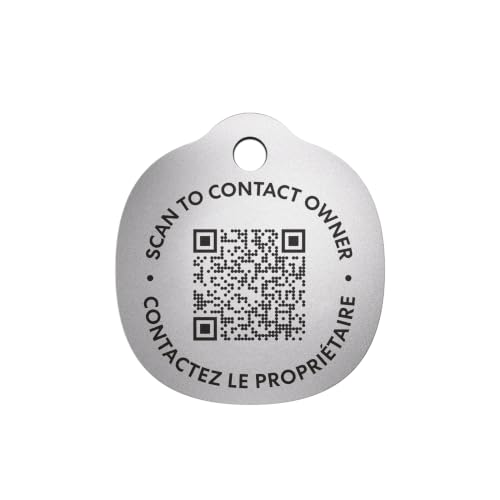
The Life360 Smart QR Code Pet ID Tag takes the simplest approach that could work: a stainless steel tag engraved with a QR code, no battery required. Any stranger with a smartphone can scan the code and reach you through the Life360 app or via call or text, with no app required on their end. That single-scan mechanic removes a surprising amount of friction when a pet is found wandering.
Unlike the Life360 Pet GPS Tracker reviewed earlier, this tag does not actively broadcast location. It depends on someone finding your pet and scanning, then sharing their location with you. For households that want a one-time setup with zero subscription fees, the trade-off feels fair.
What Pays Off
- One scan from any smartphone reaches you, no finder app needed.
- Stainless steel construction handles daily collar wear.
- No battery and no subscription fees keep ownership simple and predictable.
- Shared Care Reminders help families coordinate feeding and walks.
- Connects to Life360’s Pet Finder Network for community-supported recovery.
Small Caveats
- Reactive rather than proactive: you only learn the pet’s location when a finder scans the tag.
- The QR code may wear or scratch over years of collar use, so periodic inspection is wise.
Right Fit For
Budget-focused pet owners, multi-cat households, and anyone who’d rather skip monthly fees than have constant GPS pings.
Consider Something Else When
Owners who want automatic, real-time tracking without depending on a stranger’s scan should consider the Life360 Pet GPS Tracker for Dogs.
The Uniden R4W is built for drivers who log serious miles and want eyes on the road well ahead of the curve. Extreme long-range detection pairs with a Blackfin digital signal processor, which is a chip designed to filter noise and pick out real radar signatures faster. Built-in GPS, Wi-Fi, and Bluetooth layer modern connectivity onto a traditional radar detector core, and voice alerts keep your focus where it should be: driving.
The R/TACH companion app and a database of red light and speed camera locations add a community-data layer, something standalone radar detectors used to lack. Compared with the Optimus OBD Plug-in Car GPS Tracker reviewed next, this unit is about situational awareness rather than fleet-style position logging.
A Few Highlights
- Extreme long-range detection with Blackfin DSP for cleaner signal reads.
- 360-degree awareness covers front, rear, and side encounters.
- Built-in GPS, Wi-Fi, and Bluetooth handle updates and pairing without a cable.
- Voice alerts and an OLED display share information without demanding a long glance.
- R/TACH app compatibility and a red-light and speed-camera database enrich real-world use.
Room For Improvement
- Windshield mounting can draw attention in states or jurisdictions where detectors are restricted, so check local rules before installation.
- Wi-Fi updates need a remembered network; first-time setup at home takes a few minutes longer than a basic model.
Whose Shelf It Belongs On
Long-haul commuters, road-trippers, and enthusiast drivers who want maximum warning time and modern connectivity in one unit.
Where Another Pick Suits Better
Owners who care more about vehicle location history than radar alerts should consider the Optimus OBD Plug-in Car GPS Tracker instead.
The Optimus OBD Plug-in Car GPS Tracker plugs into your vehicle’s OBD-II port, which is the same diagnostic connector mechanics use to pull error codes. Setup involves no wire splicing, and the included extension cable helps when the port sits in an awkward spot under the dash. Once connected, the tracker reports location, address, speed, and driving history on a map.
Push, email, and text alerts cover the scenarios parents and fleet operators care about: movement, speeding, entering or leaving zones, and disconnection from the OBD port. Compared with the Optimus 3.0 GPS Tracker Bundle reviewed later, this unit is permanently installed and powered by the car, so there’s no battery to recharge.
Everyday Wins
- Plug-in OBD-II install needs no tools, wire cutting, or electrical know-how.
- Tracks every 30 seconds and on every turn, with an option to upgrade to 10-second reporting.
- Real-time alerts cover speeding, geofence crossings, and disconnection events.
- Cross-platform viewing on Android, iPhone, tablet, or browser.
Points To Note
- Requires a monthly subscription, which adds to the total cost of ownership over time.
- Older vehicles without an OBD-II port cannot use this tracker.
- OBD port placement varies by car, so the extension cable is worth keeping accessible.
Made For
Parents of new teen drivers, small fleet operators, and anyone wanting always-powered vehicle tracking without hardwiring.
Reach For A Different Pick When
Drivers who need tracking on multiple vehicles without dedicated ports should consider the Optimus 3.0 GPS Tracker Bundle with magnetic mount instead.
The Life360 Tile is a Bluetooth tracker you attach to the things that constantly go missing: keys, a daily backpack, a gym duffel. Tap the app to ring the Tile when it’s nearby, or check the last known location on a map when it’s not. A double-press of the Tile button flips the script and rings your silenced phone, which is the underrated feature for anyone who misplaces their device under couch cushions.
Compared with the DERAX Air Tracker Tag reviewed earlier, Tile leans into Life360’s wider community-finding network. If you mostly need a tracker for in-house and neighborhood-level recovery rather than cross-platform flexibility, this one fits the bill.
Advantages To Know
- Loud ring helps you find a tagged item hiding under paperwork or behind furniture.
- Last-location map view gives you a starting point when an item is far away.
- Double-press to ring your phone, even on silent, rescues lost phones quickly.
- Works with both iOS and Android, no platform lock-in for the basic functions.
Things To Weigh
- Bluetooth range is shorter than GPS-based trackers; performance drops behind walls or in dense crowds.
- Replaceable battery life varies with usage, so periodic swaps are part of the routine.
Best Suited To
Forgetful households, students, and anyone who wants a no-fuss tracker for the everyday items that vanish in plain sight.
A Better Fit Elsewhere
Shoppers wanting cross-platform flexibility and longer battery life should consider the DERAX Dual System Air Tracker Tag instead.
The Optimus 3.0 GPS Tracker Bundle is built for situations where you cannot or do not want to hardwire anything. The twin magnet case snaps onto metal surfaces, so it can hide under a trailer frame, inside a wheel well, or inside a machinery compartment. Real-time tracking at one-minute intervals runs on the internal battery, with the option to shorten to 10-second updates when you need finer resolution.
Customizable text and email alerts cover the basics: movement, geofence crossings, and low-battery warnings. Compared with the Optimus Wired GPS Tracker reviewed below, this one trades permanent power for portability, which suits trailers, rented equipment, or anything that moves between vehicles.
Standout Benefits
- Twin magnet case lets you attach the unit without brackets or mounting hardware.
- Up to two months of battery at the default 1-minute update setting.
- Customizable position updates from one minute down to 10 seconds.
- Text and email alerts cover motion, geofences, and battery status.
A Few Limitations
- Requires a monthly subscription, and frequent 10-second updates drain the battery faster.
- The magnetic case works only on ferrous metal, so composite panels need another approach.
Feature Rundown
Perfect Match For
Owners of trailers, contractors with mobile equipment, and anyone tracking assets that rotate between vehicles.
Skip It When
Shoppers wanting always-on vehicle power without recharging should consider the Optimus Wired GPS Tracker for Vehicles instead.
The Optimus Wired GPS Tracker hardwires directly to a vehicle’s battery using just two wires: positive and negative. Once installed, it draws constant power and runs without battery swaps, which is the right call for long-term fleet monitoring or any vehicle you want to track for years. Thirty-second reporting with every-turn precision covers daily driving, with an upgrade path to 10-second reporting when finer detail matters.
The subscription model is straightforward and contract-free, which is unusual in the hardwired tracker space. Compared with the Optimus 3.0 GPS Tracker Bundle reviewed earlier, this unit trades portability for set-and-forget reliability.
Strengths Worth Knowing
- Hardwired two-wire install draws constant power from the battery, no recharging.
- 30-second default reporting with optional faster intervals for fine tracking.
- No contract, with freedom to cancel the monthly plan anytime.
- Best fit for cars and trucks needing long-term, low-maintenance tracking.
Practical Considerations
- Hardwiring requires basic comfort with vehicle electrical connections or a professional install.
- Monthly subscription is part of the long-term cost.
- Always-on draw means very long parked periods without driving may affect the starting battery.
Who Should Grab It
Small business owners, fleet managers, and committed long-term trackers who want set-and-forget operation over portability.
Not Your Match When
Drivers who rotate the tracker between vehicles should consider the Optimus 3.0 GPS Tracker Bundle with magnetic mount instead.
What Matters Most Before Choosing Electronics Gps Devices
Match The Tracker To The Asset
Pets, people, keys, and vehicles each place different demands on a tracker. Pets need lightweight, weather-tolerant hardware that stays put on a collar; key finders need a loud ring and a slim profile; vehicles need either plug-in simplicity or hardwired reliability. Picking the wrong category leads to trade-offs you’ll feel every day, like a bulky tag on a small cat or a tracker without geofencing on a teen driver.
Understand Battery Versus Subscription Models
Rechargeable units offer zero recurring fees but demand a charging routine; battery-powered units last months or years but require occasional replacements. Subscription-based trackers include cellular coverage, real-time alerts, and richer apps, yet the monthly cost compounds over time. For low-stakes items like keys, a no-subscription model often makes sense; for a vehicle you depend on, the subscription usually pays for itself in theft recovery and driver accountability.
Range And Reporting Frequency Set Expectations
Bluetooth finds tagged items within roughly 100 to 300 feet, while cellular GPS trackers report anywhere with cell coverage. Reporting intervals from one minute down to 10 seconds affect both battery life and the granularity of the location history. Choose tighter intervals for theft-prone assets; choose longer intervals for pets that mostly stay in a yard.
Consider How The Tracker Fits Your Daily Routine
A clunky tracker on a keychain gets removed and forgotten; an OBD tracker in an awkward dash port stays plugged in for years. Think about charging access, mounting surfaces, and whether the tracker has to survive rain, mud, or a curious pet. The best device is the one you’ll actually leave attached.
Key Considerations Across These Picks
Pitfalls Shoppers Hit
Treating subscription price as the deciding factor often backfires when the cheaper plan lacks geofencing or speeding alerts you actually need. Buying a Bluetooth tracker to monitor a vehicle leaves you with a device that only works within a few hundred feet. Skipping the platform check is another common miss: an Apple-only tracker on an Android phone is a paperweight. Match the tracker to the asset, the ecosystem, and the alerts you expect to use.
What The Higher Tier Buys
Premium tracking devices typically add longer battery life, faster reporting intervals, and richer app features like driver scoring or crash detection. Hardware quality also steps up, with weather sealing, stronger magnets, or better mounting options. The upgrade pays off when you depend on the device daily or for high-value assets; for a spare key, the extra spend is hard to justify.
Frequently Asked Questions
Do GPS trackers require a monthly fee?
Many do, especially cellular GPS units designed for vehicles and pets, because the subscription covers network access and app features. Pure Bluetooth trackers like Tile or DERAX typically do not require a fee, but their tracking range is much shorter.
How long does the battery last on a GPS pet tracker?
Battery life varies widely, from a few days on real-time LTE models to several years on a coin-cell Bluetooth tag. Look at the manufacturer’s stated life and match it to how often you’d actually charge the device.
Can a tracker help recover a stolen vehicle?
Yes, real-time GPS vehicle trackers with quick location updates and geofence alerts give the best chance of recovery. The faster it reports, the sooner you and law enforcement can act.
Are Bluetooth trackers accurate enough for finding keys?
For keys and similar small items, Bluetooth trackers are usually accurate enough, especially with a loud ring. They are less helpful for items left far away, where the last-known location is your starting point.
What’s the difference between a hardwired and a plug-in vehicle tracker?
A plug-in tracker uses the OBD-II port and installs in seconds with no tools, while a hardwired tracker connects directly to the battery and stays powered indefinitely. Plug-in units are easier to move; hardwired units are better for permanent installs.
Bottom Line
The right tracker is the one that matches the asset and the routine: a proactive GPS collar for an escape-prone dog, a Bluetooth tag for daily keys, a magnetic bundle for trailers, and a hardwired unit for long-term fleet use. Start with the asset, then narrow by power source, subscription willingness, and ecosystem, and you’ll land on a tool that earns its keep.


