

Cord-cutting shouldn’t feel like guesswork. A solid indoor antenna pulls in the local networks you actually watch (NBC, ABC, CBS, FOX, PBS) in clear 1080p or 4K, no subscription required. The right pick depends on how far you live from broadcast towers, what kind of walls sit between you and the signal, and whether you’d rather mount something once and forget it or move the antenna around as you settle in.
Below, nine options worth a look, ranging from flat-paper-thin panels you stick to a window to amplified outdoor-ready units with 50+ feet of coax. Each one handles the basics a little differently, so the right match comes down to your living space, your tower distance, and how much fiddling you can tolerate.
An Overview Of The Picks

Susbrothe 6000+ Miles Range TV Antenna
Qboy 2026 TV Antenna Indoor 5000+ Miles

HIDB Indoor TV Antenna with Magnetic Base
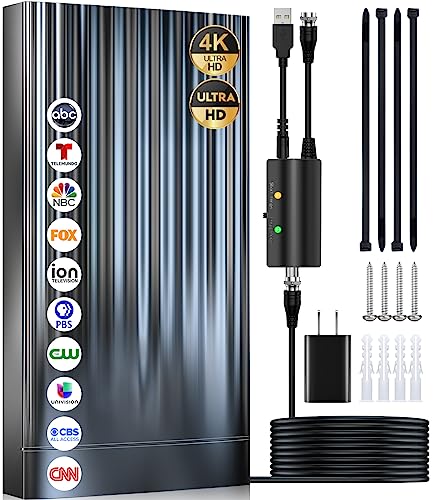
ophirs 6000+ Miles TV Antenna with Amplifier
Qellaff 2026 Smart TV Antenna Indoor
Arrasolt Melas 5000+ Miles TV Antenna

YiziAifsion 2026 TV Antenna Indoor 25ft Cable

HIDB TV Antenna for Smart TV

HIDB Rabbit Ears TV Antenna
More Details On Our Top Picks
For households sitting 30 to 60 miles from the nearest broadcast tower, an amplified panel like the Susbrothe tends to land in the sweet spot. The flat design mounts to a window, a wall, or a pole outside, which matters because the rule with any antenna is the same: higher and less obstructed almost always wins.
Unlike flat paper-thin options that rely solely on placement, this one ships with an inline amplifier, so it can claw back some of the signal lost through stucco, foil-backed insulation, or older double-pane windows. Most owners tend to run the included coax straight to the TV and rescan channels after a few minutes of repositioning.
Practical Advantages
- Dual indoor and outdoor mounting opens up higher placement, which usually means stronger reception.
- Built-in amplifier helps in areas where walls and siding eat into the signal.
- Slim profile keeps it out of the way in living rooms where aesthetics matter.
- Captures the major local networks (ABC, CBS, NBC, FOX, PBS) in uncompressed HD.
Things To Consider
- Amplified antennas can occasionally overload in suburban areas sitting close to towers, producing odd blocky artifacts on a few channels.
- Window-mount adhesive can leave residue on painted surfaces when removed.
Quick Facts
Made For
Suburban and rural households who need flexible mounting and amplification to push past the usual wall-and-roof losses.
Skip It When
You sit within 15 miles of broadcast towers; the Qellaff 2026 Smart TV Antenna Indoor covers that scenario with less hardware.
ATSC 3.0 is the next-generation broadcast standard rolling out across the US, and it brings 4K resolution, HDR, and improved audio to free over-the-air TV. The Qboy supports it, which is the headline reason to look at it over older flat panels. Think of it as a small hedge against a standards transition that is still mid-flight in many markets.
The build follows the familiar amplified-paper template, so setup is mostly stick-the-panel-and-scan-channels. The trade-off is that ATSC 3.0 availability depends entirely on your local affiliates, so the future-proofing only pays off in cities where stations have already upgraded.
Strengths Worth Knowing
- ATSC 3.0 support unlocks 4K and HDR broadcasts where local stations have upgraded.
- Pulls in the standard major networks, plus extras like CW and Univision depending on tower proximity.
- Lightweight enough to move between rooms during initial placement testing.
Worth Noting
- ATSC 3.0 coverage remains uneven, so the feature may sit dormant in some regions for years.
- Amplifier needs a USB power source, which adds one more cable to manage behind the TV.
Right Fit For
Viewers in metro areas with active ATSC 3.0 rollouts who want a flat indoor antenna that won’t feel dated the moment a local station upgrades.
Where Another Pick Suits Better
Rural households far from any tower should reach for the ophirs 6000+ Miles TV Antenna with Amplifier instead, since cable length and amplification matter more than tuner standards out there.
The 360-degree omnidirectional design on this HIDB model is the main reason to consider it over directional flat panels. Instead of aiming the antenna at a tower, you set it down and it pulls signals from all directions. That’s a quiet relief in apartments where the broadcast tower might be in any direction or even blocked partially by a neighboring building.
The magnetic base is a small but useful touch. It sticks to the back of a metal TV stand, a window frame, or a filing cabinet, which means no adhesive and no holes in drywall when you move out. The 8.2-foot cable is on the short side, so placement is somewhat tethered to where the TV sits.
Positive Points
- Omnidirectional reception removes the need to aim the antenna precisely at a tower.
- Magnetic base allows repositioning in seconds without leaving residue.
- Compact form disappears behind most modern TV stands.
Trade Offs
- Short 8.2-foot cable may not reach a window from a wall-mounted TV.
- Omnidirectional designs can pick up more interference in dense urban environments.
Best Suited To
Renters and apartment dwellers who can’t drill holes or stick adhesive panels to exterior walls.
Consider Something Else When
You want a clean window-mount setup with a long cable run; the YiziAifsion 2026 TV Antenna with its 25-foot cable handles that layout more comfortably.
When the TV sits in a basement or interior room and the antenna needs to live on the roof or in an attic, cable length becomes the whole game. The ophirs package includes a 52-foot coax run, which is enough to snake through most attics, around HVAC ducts, and down to a ground-floor TV without an extension.
The amplifier and AC adapter are part of the kit, so signal strength gets a boost before the long cable run saps any of it. Compared to the Susbrothe, this one leans harder into permanent-installation thinking rather than casual placement.
Everyday Advantages
- 52-foot coax handles long indoor-to-outdoor routing without buying extensions.
- Supports 4K, 8K, and 1080p broadcasts depending on local station output.
- AC adapter powers the amplifier at the wall, avoiding USB port dependency on older TVs.
Room For Improvement
- Long coax can be tricky to hide cleanly along baseboards and through wall plates.
- Heavier outdoor mounting requires proper anchoring in high-wind regions.
Who Will Love This
Anyone planning a permanent rooftop or attic install where the TV sits far from the antenna and cable routing is a real constraint.
Reach For A Different Pick When
You’d rather not run cable through walls; the Susbrothe 6000+ Miles Range TV Antenna is friendlier to a temporary or apartment setup.
The Qellaff sits in the middle of this list because it doesn’t try to specialize. It’s a competent amplified flat panel that handles the full range of broadcast formats (720p, 1080i, 1080p, 2K, 4K HDR) and pulls in the usual suspects like ABC, CBS, NBC, PBS, FOX, Univision, and HSN.
For a household where the antenna is going to live behind the TV on a stand, get plugged in once, and then be forgotten, the Qellaff is a sensible default. It doesn’t have the cable length of the ophirs or the magnetic repositioning of the HIDB, but it covers the standard living-room scenario without any quirks.
What Works In Its Favor
- Format support covers everything from 720p legacy broadcasts up through 4K HDR.
- Slim panel slips behind most TVs without being visible from the front.
- Setup stays in the standard stick-to-wall, scan-channels flow.
Small Caveats
- No standout feature to justify it over cheaper alternatives if reception in your area is already strong.
- Amplifier draw adds a small ongoing cost to the TV’s USB port if powered that way.
The Right Fit
Main living-room TVs in suburban areas where reception is average and the goal is a clean, set-and-forget install.
Look Elsewhere When
You’re close to broadcast towers and want a cheaper alternative; the HIDB Rabbit Ears TV Antenna is hard to beat for that specific scenario.
The Arrasolt Melas doubles as both an indoor panel and an outdoor unit, which is a useful middle path for people who aren’t sure which route they’ll take. Start with a window mount, and if reception still misses channels, move it to a porch or balcony without buying a second antenna.
Compared to the Susbrothe earlier in the list, this one offers a similar dual-use approach but skips some of the marketing language around extreme range figures. The honest read is that real-world range depends almost entirely on your tower distance and line of sight, not on the number printed in the product name.
A Strong Showing
- True indoor-outdoor adaptability means you can test placement without buying twice.
- Captures the major broadcast networks plus regional sports and Spanish-language channels.
- Weather-resistant enough for covered porches and sheltered outdoor spots.
Points To Note
- Lacks the very long coax run of the ophirs, so attic or rooftop installs may need an extension.
- Setup instructions can feel thin, especially for first-time antenna owners.
Who Should Grab It
First-time cord-cutters who want flexibility to try both indoor and outdoor placement before committing to a permanent install.
Swap It Out When
You already know the install will be permanent and outdoors; the ophirs 6000+ Miles TV Antenna with its 52-foot cable is built for that scenario.
Bedrooms, dorm rooms, and bonus rooms often have the TV in an awkward spot relative to the nearest window. The 25-foot cable on the YiziAifsion is generous without going to the full rooftop-install territory, so you can usually snake it to a high window even when the TV sits in a corner.
The smart IC chip handles signal optimization, which is a fancy way of saying it filters out some of the noise that long coax runs can pick up. The 4500+ mile range figure should be read with the same skepticism as every other number in this category; what matters is your real distance to the tower.
Why It Works Well
- 25-foot cable reaches high windows from TV stands placed in less convenient spots.
- Simple stick-and-scan setup with no extra amplifier box to manage.
- Light enough to mount with standard adhesive strips.
Practical Considerations
- No external amplifier, so it may underperform in rural settings 50+ miles from towers.
- Adhesive mounting can sag over time on textured walls.
Perfect Match For
Dorm rooms, guest bedrooms, and secondary TVs in homes where the main antenna already handles the living room.
A Better Fit Elsewhere
Primary living-room installs in weak-signal areas; the Susbrothe 6000+ Miles Range TV Antenna with its amplifier handles that situation more reliably.
This older HIDB listing has been around long enough that the design is essentially a known quantity. The flat panel uses a dual-PC soft material rather than standard PVC, which is a small but real point in homes where flame-retardant materials matter, such as around kids’ rooms or older buildings.
It’s a competent standard flat antenna for areas with decent broadcast coverage. Where it shows its age is in the range figures and the lack of amplification, so it really shines within roughly 30 miles of towers and starts to lose steam beyond that, depending on obstructions.
Useful Strengths
- Flame-retardant dual-PC housing adds a layer of safety over standard PVC builds.
- Time-tested design with enough owners using it to give the format credibility.
- Slim enough to disappear behind a wall-mounted TV.
Honest Caveats
- No built-in amplifier, so it leans on placement more than other picks on this list.
- Specs feel dated compared to the 2026 flagships with longer cable runs and ATSC 3.0 support.
Built With In Mind
Urban and close-in suburban households where towers are nearby and amplification isn’t necessary.
Not Your Match When
You live in a rural area or anywhere the broadcast towers are 40+ miles away; the ophirs 6000+ Miles TV Antenna with its amplifier and long cable is the more honest choice there.
Rabbit ears feel like a relic until you live close to broadcast towers, and then they’re honestly hard to beat. The adjustable dipole design lets you tune reception by physically moving the two telescoping rods, which sounds old-school but works because physics hasn’t changed.
This is the right pick when the towers are within roughly 25 miles and you want a no-amplifier, no-flat-panel, no-fuss option. The trade-off is that rabbit ears don’t hide well, so it’s really a living-room or workshop antenna, not a designer-friendly bedroom piece.
Notable Gains
- Adjustable dipole lets you fine-tune reception by hand, which often beats flat panels in strong-signal areas.
- No amplifier means no extra power draw or USB cable to manage.
- Compatible with all smart TVs that have a standard coax input.
Where It May Fall Short
- Visually old-fashioned, which matters in shared living spaces.
- Limited range compared to amplified options; struggles beyond 25-30 miles from towers.
Whose Shelf It Belongs On
Anyone within 25 miles of broadcast towers who wants a simple, no-amplifier solution for a workshop, kitchen, or spare TV.
Where A Sibling Pick Shines
Bedrooms where aesthetics matter more; the Qellaff 2026 Smart TV Antenna Indoor sits flat behind the TV and disappears.
What To Weigh Before Choosing Your Antenna
Distance to the nearest broadcast tower is the single biggest factor in antenna performance. The FCC’s DTV reception map can show you exactly which channels are available at your address and from which direction. Most modern flat-panel antennas handle ranges up to about 35 miles cleanly, while amplified units push that further but can sometimes overload in dense urban areas.
Indoor versus outdoor placement matters as much as the antenna itself. An inexpensive outdoor antenna mounted high will usually beat a premium indoor panel stuck to a TV stand. Walls, foil-backed insulation, and low-emissivity window coatings all eat into signal strength, so whenever possible, the shortest path to the sky wins.
Cable length often gets overlooked, but it determines where you can physically place the antenna. Measure the path from your TV to the highest reasonable window or wall before buying. A 50-foot coax run with a small signal loss is often a better trade than cramming a flat panel behind a TV in a basement.
Amplification helps in weak-signal areas but isn’t free. Boosted antennas can introduce noise, and in strong-signal zones they can overload the tuner, producing artifacts. A non-amplified panel within 20 miles of towers usually outperforms an amplified one stuck in a basement.
Key Considerations Across These Picks
Common Shopping Slip Ups
The biggest mistake is buying the antenna with the highest range number and assuming it’ll work everywhere. Range figures are marketing-friendly but rarely match real-world performance, which depends on terrain, building materials, and tower height. A $30 flat panel 10 feet from a window will often outperform a premium amplified unit in a basement.
Another trap is skipping the channel scan step. TVs need a fresh channel scan whenever you move the antenna, and most cord-cutters undervalue small repositioning. Shifting a panel six inches along a window can be the difference between 12 channels and 35.
Where The Extra Money Goes
Spending more on an antenna usually buys longer cable, better build materials, or a more refined amplifier. The ophirs with its 52-foot coax is a good example: the premium pays for routing flexibility rather than raw reception. In weak-signal areas, that cable length can matter more than a fancier amplifier.
The ATSC 3.0 support on the Qboy is a different kind of premium. You’re paying for tuner compatibility with a broadcast standard that’s still rolling out. In markets where local affiliates have already upgraded, that future-proofing starts to pay off immediately. Elsewhere, it’s a quiet insurance policy.
Frequently Asked Questions
Do indoor antennas really work without cable?
Yes. Indoor antennas receive free over-the-air broadcast signals from local networks like ABC, CBS, NBC, FOX, and PBS. The catch is that performance depends on your distance from broadcast towers and the building materials between you and the signal.
How far can an indoor antenna really reach?
The “miles” figures on packaging are best-case maximums. Real-world reception depends on terrain, obstructions, and antenna height. Most flat panels perform well within 35 miles, while amplified units can push further but may overload in dense urban areas close to towers.
Will a TV antenna work with any TV?
Modern smart TVs all include a built-in ATSC tuner, so any antenna with a standard coax connection will work. You’ll need to run a channel scan after connecting the antenna, and the process is the same whether the TV is a budget set or a flagship OLED.
Where should I place my indoor antenna for the best signal?
Higher is better, and a window facing the broadcast tower is the ideal spot. If you don’t know which direction the towers are, the FCC’s DTV reception map can show you. Rescanning channels after each small repositioning is the fastest way to find the sweet spot.
Do amplified antennas really make a difference?
Amplification helps in weak-signal areas where the signal has to travel through walls, siding, or long cable runs. In strong-signal areas, the amplifier can actually overload the tuner and cause artifacts, so a non-amplified panel is often the better pick within 20 miles of towers.
Closing Thoughts
The right antenna comes down to a few honest questions: how far are the towers, where will you mount it, and how much cable do you need to get there. The Susbrothe handles the most common scenarios well, the ophirs wins for permanent outdoor installs, and the HIDB Rabbit Ears remains a smart, no-fuss option when towers are close by. Pick based on your real layout, not the highest number on the box, and rescan channels after any repositioning.


