

Producing music at home used to mean hauling rack gear into a spare bedroom. These days, the right pair of compact monitors can turn a desk into a workable studio, and a few clever picks in this list do exactly that. You don’t need a treated room or a degree in acoustics to hear the difference a flat, honest speaker makes on a rough mix. Whether you’re sketching beats, tracking vocals, or just want playback that doesn’t flatter your mistakes, there’s something here that fits the way you work.
A Side-By-Side Look

FUNLOGY 14W Stereo PC Speakers, White

VKheroKV C-1 Desktop Speaker Stands (Gray)

PreSonus Eris E3.5 Near Field Studio Monitors

Divoom MiniToo Retro PC-Style Speaker

BESTISAN Computer Speakers with Bluetooth

FUNLOGY 14W Stereo PC Speakers, Black
Creative Pebble 2.0 USB Desktop Speakers
Logitech Z625 THX 2.1 Speaker System

JBL Professional 305PMkII Powered Monitor

FUNLOGY Portable Mini2 Bluetooth Speaker
Inside Each Recommended Option
A small desk doesn’t have to mean small sound, and the FUNLOGY 14W pair is a friendly reminder of that. The 30-degree upward tilt is the kind of detail that quietly matters: instead of firing into your chest, the drivers aim at your ears during long mix-down sessions, so vocals and lead synths stay intelligible.
USB power means a single cable to your laptop and no wall wart clutter, which is honestly liberating in a tight workspace. The analog volume dial lives right on the front, so you can nudge levels without tabbing back into your DAW (digital audio workstation, the software you record and arrange music in).
What Earns Its Place
- Palm-friendly footprint frees up desk real estate for MIDI controllers or a notebook.
- Passive radiators (small unpowered cones that vibrate with the air inside the cabinet) help the 48mm drivers push a fuller low end than the size suggests.
- Single-cable USB power keeps setup clean and portable between rooms.
- Front-mounted volume dial avoids the alt-tab dance during a session.
Things To Consider
- These are consumer speakers, so they flatter your tracks a little. Critical mixing decisions deserve a flatter monitor like the PreSonus Eris E3.5 in slot 3.
- White plastic can show dust over time, so a quick microfiber wipe every week keeps it looking fresh.
Key Specs
Made For
Anyone producing casually in a small bedroom or dorm who wants honest-enough playback without dedicating a whole shelf to gear.
Look Elsewhere When
You’re mixing tracks that will ship commercially and need a flatter response, in which case the PreSonus Eris E3.5 in slot 3 is a smarter investment.
Speaker stands aren’t the sexiest purchase in a studio, but the VKheroKV C-1 pair solves a problem most beginners never realize they have. Tiny monitors sitting flat on a desk fire sound straight into your keyboard instead of your ears, and you lose a surprising amount of detail that way.
The 16-degree upward angle is the whole point. Pair these with the Creative Pebble 2.0 in slot 7 or the PreSonus Eris E3.5 in slot 3, and you’ll suddenly hear details in your hi-hats and reverb tails that used to vanish.
Advantages To Know
- Steel construction keeps the pair stable at louder volumes without sliding.
- Foam padding underneath dampens vibration that would otherwise muddy bass response.
- Compact footprint fits neatly under most monitors without crowding the desk.
- Pair design means both speakers get matched alignment, which matters for stereo imaging.
Worth Noting
- These are stands, not speakers. You still need a separate audio source like the Divoom MiniToo in slot 4 or the BESTISAN pair in slot 5.
- The 7.7 lb weight limit means they’re not suitable for larger 6-inch or 8-inch studio monitors.
Feature Snapshot
Best Suited To
Producers who already own small monitors and want a quick sonic upgrade without replacing their speakers.
A Better Fit Elsewhere
Anyone who hasn’t picked monitors yet should start with the PreSonus Eris E3.5 in slot 3 and add stands later as their setup grows.
If you’ve read any home-studio forum, the PreSonus Eris E3.5 pair shows up constantly, and for good reason. These are true near-field monitors, meaning they’re designed to be heard up close at low volume, where the room affects the sound less. The 3.5-inch woven composite drivers (lightweight cones woven from a stiff fiber blend that stays rigid while moving) give you a flatter response than the FUNLOGY in slot 1, so what you hear is closer to what your mix actually sounds like.
Front-panel 1/8-inch input means you can plug a phone in for a quick reference track without crawling behind the cabinet. Rear-panel TRS (balanced quarter-inch, a pro-audio connector that rejects electrical noise) and RCA inputs cover your audio interface and any older gear lying around.
A Favorable Mix
- Honest, uncolored sound reveals mix issues instead of hiding them.
- Multiple input types let you swap between interface, phone, and legacy gear without re-plugging.
- Bundled Studio One Prime and plug-in suite adds real production value out of the box.
- Compact size still fits beside a laptop on a standard desk.
Honest Caveats
- The 3.5-inch drivers don’t reach the deepest sub-bass, so EDM and cinematic mixes may need a subwoofer later.
- Owners commonly report the included cable run is short, so plan on a longer interconnect for flexible placement.
Key Attributes
Right Fit For
First-time producers who want their first proper set of monitors and care more about mix accuracy than thumping bass.
Skip It When
You produce bass-heavy electronic music and want a fuller low-end out of the box, in which case the Logitech Z625 in slot 8 or a future subwoofer makes more sense.
Most computer speakers try to disappear into the desk. The Divoom MiniToo does the opposite, and that’s the charm. Shaped like a tiny 90s PC, this 5W near-field speaker has a 1.77-inch pixel display on the front that shows custom animations, clock faces, and pixel art from the companion app.
It’s a single speaker, not a pair, which is worth knowing upfront. For casual listening and on-camera streaming it’s plenty, but it won’t replace the stereo field you’d get from the PreSonus Eris in slot 3.
The Practical Payoff
- The pixel screen adds personality that generic black boxes never will, great for Twitch frames and YouTube backgrounds.
- Warm, vocal-friendly tuning suits podcasts, lo-fi beats, and chill playlists well.
- Compact size makes it a fun desk mascot rather than a serious space hog.
Points To Keep In Mind
- It’s a single speaker, so stereo mixing decisions can’t rely on it alone.
- The companion app unlocks the fun features, which adds an extra step for shoppers who just want to plug and play.
- Not aimed at producers tracking critical decisions; treat it as a creative accessory instead.
Who Should Grab It
Streamers, content creators, and anyone whose desk doubles as a backdrop for video work.
Swap It Out When
You need honest stereo imaging for mix decisions, in which case the PreSonus Eris E3.5 in slot 3 is the right tool for that job.
Flexibility is the whole pitch for the BESTISAN pair. You get RCA inputs for legacy gear, optical input for a lossless digital connection from a TV or game console, and Bluetooth when you want to wander the room with your phone. That’s a wider input spread than most desktop speakers at this size.
The tuning leans consumer-friendly, with boosted bass and a lively midrange. Great for casual playback and gaming, slightly colored for true mixing work.
Good Reasons To Consider
- Bluetooth mode adds wireless playback without dongles or adapters.
- Optical input handles lossless digital audio from consoles and TVs cleanly.
- Switching between inputs is faster than unplugging cables behind a desk.
Where It Is Less Suited
- The bass-boosted tuning flatters mixes, so don’t trust it as your only reference.
- White plastic collects fingerprints and scuffs over time, depending on placement.
Quick Facts
Perfect Match For
Households where the speakers connect to a PC, a console, and a phone on rotation without re-cabling.
Reach For A Different Pick When
You need flatter reference sound for mix decisions, in which case the PreSonus Eris E3.5 in slot 3 is a better fit.
The black version of the FUNLOGY pair is functionally identical to the white one in slot 1, just dressed for a darker aesthetic. Same 14W output, same 30-degree tilt, same passive radiators doing quiet bass work behind the scenes.
It earns its own place on this list because so many producers want a stealthy setup that fades into a black desk. Dark plastic hides fingerprints better than the white variant, which is a small but real ownership perk.
What Pays Off
- Matte black finish blends with most monitor arms and dark desks.
- Same single-cable USB power as the white version keeps setup painless.
- 30-degree tilt works regardless of room size or chair height.
Some Limits To Know
- Same consumer tuning as the white version, so still flattering rather than flat for mixing.
Whose Shelf It Belongs On
Aesthetic-focused producers who want tidy audio without a bright white speaker competing for attention.
Consider Something Else When
Mixing accuracy matters more than looks, in which case the PreSonus Eris E3.5 in slot 3 remains the better tool.
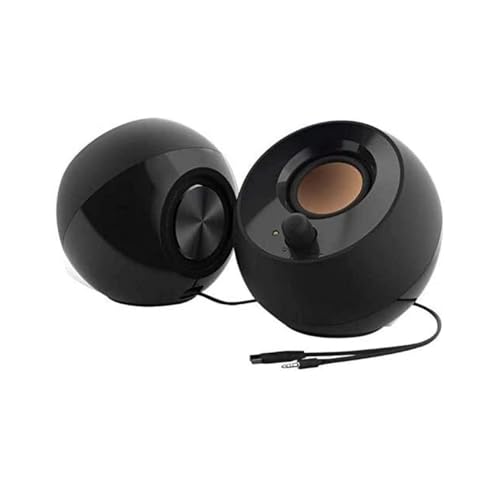
Sometimes you just want a pair of speakers that work without thinking about them. The Creative Pebble 2.0 pair runs on a single USB cable for both power and audio, so there’s no wall wart, no driver install, no settings menu to dig through.
The 45-degree elevated drivers aim the sound up toward your ears instead of at your keyboard, which is a thoughtful touch at this size. For most desk setups, you plug them in and forget they’re there.
Useful Touches
- Single USB cable means true plug-and-play with any modern laptop.
- Rear-facing passive radiators add bass weight beyond the small cabinet.
- Minimalist orb design looks cleaner than most brick-shaped speakers.
Potential Drawbacks
- The small drivers don’t push deep bass, so don’t expect subwoofer-like rumble.
- Volume maxes out lower than larger sets, which can matter in shared spaces.
- Plastic finish can scratch if you reposition the pair often.
Core Details
Built With In Mind
Producers who travel between home, the office, and shared spaces and want one speaker pair that works everywhere.
Not Your Match When
You want louder playback or deeper bass response, in which case the Logitech Z625 in slot 8 makes more sense.
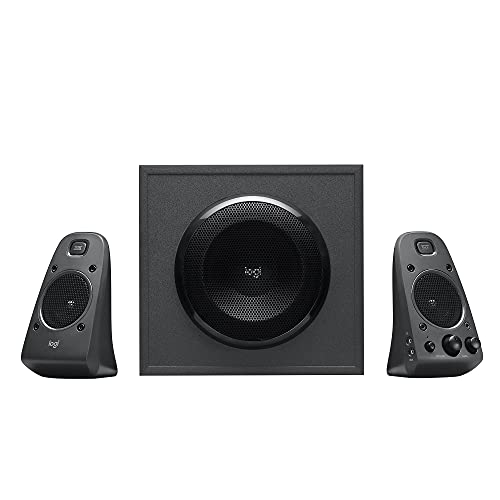
The Logitech Z625 is the heaviest hitter in this roundup, and it earns that label honestly. The 2.1 setup adds a real subwoofer (a dedicated low-frequency speaker) to the pair of satellites, which means you actually feel the sub-bass instead of just guessing where it should be. THX certification is a third-party audio standard that benchmarks volume and clarity, and the optical input lets you run a lossless digital feed from a console or TV.
You also get up to three simultaneous inputs, so a PC, a console, and a TV can stay plugged in at once. Switching sources is a matter of pressing a button on the control pod.
The Helpful Details
- Real subwoofer fills the low end that smaller monitors can’t reach.
- Optical, 3.5mm, and RCA inputs cover most home audio gear at once.
- THX-certified tuning targets consistent volume and clarity across sources.
- Wired control pod keeps volume and source switching within reach.
Where It May Fall Short
- It takes up more floor space than the desktop pairs above, which matters in tight rooms.
- The subwoofer can overpower a small desk setup if you place it too close to a wall.
- For pure mix work, the colored bass tuning may mislead decisions compared with the PreSonus Eris in slot 3.
Made For
Producers who also use their setup for gaming and movies and want one system that does it all.
Where Another Pick Suits Better
You need genuinely flat reference monitors for critical mixing, in which case the JBL Professional 305PMkII in slot 9 is a serious step up.
JBL’s 305PMkII is the upgrade move when you’ve outgrown beginner monitors and want real engineering behind the sound. The 5-inch woofer (the driver handling low and mid frequencies) and 1-inch tweeter (the driver handling high frequencies) combine into what’s called a 2-way design, which separates the work cleanly between bass and treble. The MkII revision brought new transducers (the speaker components that convert electrical signal into sound) and a Boundary EQ, a rear switch that compensates for placement near walls, which is genuinely helpful in a small room.
Worth flagging: this is sold individually, so you need two for a stereo pair. That doubles the cost before you even add cables.
The Case For It
- Wider sweet spot (the listening zone where audio sounds balanced) than smaller monitors, so you don’t have to sit perfectly still.
- Boundary EQ compensates for placement near walls or corners.
- 5-inch driver reaches deeper than 3.5-inch monitors like the PreSonus in slot 3.
- Detailed imaging helps you place instruments accurately in a mix.
What To Weigh
- Sold individually, so two units are needed for stereo, which raises the total noticeably.
- Larger footprint requires real desk space or dedicated stands like the C-1 in slot 2.
- You may find the bass extension still benefits from a subwoofer for full-range mixing.
Feature Rundown
Perfect Match For
Semi-serious producers building a project room and willing to invest in a long-term reference pair.
Look Elsewhere When
You’re still learning the basics and would benefit more from the friendlier curve of the PreSonus Eris E3.5 in slot 3.
The last spot on this list belongs to a different kind of tool entirely. The FUNLOGY Portable Mini2 is a Bluetooth travel speaker with IPX7 waterproofing (the highest common splash-immunity rating, meaning it survives full submersion briefly), so it can tag along to the studio, the kitchen, or the shower without much fuss.
It’s also the one place TWS pairing matters. TWS (True Wireless Stereo) lets two of these speakers pair into a stereo set, so buying two turns this into a tiny portable stereo rig for reference checks outside the studio.
What Helps Most
- Pocket-sized form factor travels anywhere a session does.
- IPX7 waterproofing handles splashes and rain without worry.
- TWS pairing lets two units behave as a stereo pair when needed.
- Built-in mic adds quick call functionality when you’re away from your setup.
Trade-Offs To Consider
- A single unit is mono, not stereo, so buying two is the only way to get true L/R imaging.
- Not a substitute for proper studio monitors like the PreSonus in slot 3 or JBL in slot 9.
- Charging between long sessions is required if you use it heavily day to day.
The Right Fit
Producers who want a portable rig for reference playback away from the main studio, especially when traveling or collaborating off-site.
Where A Sibling Pick Shines
You actually need flat monitors for mixing at home, where the PreSonus Eris E3.5 in slot 3 or JBL 305PMkII in slot 9 are better tools for that work.
What Matters Most Before Choosing Computer Speakers For Music Production
Picking up the right pair of speakers starts with knowing what “good” actually sounds like for your work. Most producers eventually settle into a near-field monitor for serious mixing and a casual pair for everyday playback, and that’s a perfectly reasonable setup. Here’s what shapes the decision.
Flat response versus colored playback. Studio monitors aim for a flat frequency response, meaning no part of the audio range is louder or quieter than the rest, so what you hear matches the recording. Consumer speakers boost bass and treble for fun, which is great for casual listening but hides mix problems. If you’re serious about producing, lean toward flat monitors like the PreSonus Eris E3.5 in slot 3 or the JBL 305PMkII in slot 9.
Driver size and your room. Smaller drivers (3 to 3.5 inches) sound tight and focused but don’t reach deep bass. Larger drivers (5 inches and up) push more air and reach lower frequencies, but they also need space to breathe. In a small bedroom, the PreSonus Eris pair works beautifully. In a larger room, the JBL 305PMkII has the headroom to fill the space.
Input options and your gear. Audio interfaces use TRS or XLR cables, while laptops often need a 1/8-inch or USB hookup. Consoles and TVs usually output over optical. Choosing a pair that covers the inputs you actually use saves a tangle of cables and adapters.
Connectivity extras. Bluetooth is handy for casual playback from a phone, but the audio codec (the compression format used to send wireless audio) often compresses the signal in ways that mask fine detail. Treat Bluetooth as a convenience, not a critical listening path.
Key Considerations Across These Picks
A handful of patterns repeat across the category, and recognizing them helps you skip past regret.
Pitfalls Shoppers Hit
The most common mistake is buying consumer speakers for production work. The boosted bass and treble sound exciting at first, but you end up with mixes that translate poorly to earbuds and car stereos. Stick with monitors designed for the work.
Another trap is ignoring room placement. Monitors placed flat on a desk fire sound at your keyboard, losing detail in your ears. The VKheroKV stands in slot 2 solve this for a fraction of the cost of new monitors.
When Paying More Pays Off
Higher-tier monitors like the JBL 305PMkII in slot 9 buy you flatter response, wider imaging, and components that hold up for years. Worth the upgrade once you’re committing to a project room and want consistent reference playback across long sessions. Beginner producers usually don’t need this jump right away, the PreSonus Eris E3.5 in slot 3 covers the same ground more affordably.
Frequently Asked Questions
Do I need studio monitors for music production?
Technically no, but they make mixing much easier. Consumer speakers flatter your music, so mixes that sound done on them often translate poorly elsewhere. Starting with an affordable pair like the PreSonus Eris E3.5 saves a lot of headaches down the line.
What’s the difference between near-field and far-field monitors?
Near-field monitors are designed to be heard up close at low volume, so your room’s acoustics affect the sound less. Far-field monitors fill larger rooms at higher volumes. Most bedroom producers want near-field designs like the PreSonus or JBL pairs in this list.
Can I use Bluetooth speakers for music production?
Occasionally, but Bluetooth compresses audio and adds latency (a small delay between the source and the speaker, measured in milliseconds), both of which make mixing harder. Treat Bluetooth speakers like the FUNLOGY Portable Mini2 in slot 10 as reference tools or casual playback, not main monitors.
How important is a subwoofer for music production?
For bass-heavy genres like EDM, hip-hop, and cinematic music, a subwoofer helps you hear the lowest frequencies clearly. For acoustic, vocal, and indie work, a good pair of 5-inch monitors like the JBL 305PMkII reaches low enough on their own.
Should I buy speaker stands?
Yes, especially if your monitors sit on a desk. Angling the drivers toward your ears improves clarity and stereo imaging immediately. The VKheroKV C-1 pair in slot 2 is an affordable starting point for small monitors.
Bottom Line
You don’t need a giant budget or a treated room to start producing well. A modest pair of honest monitors plus good habits gets you further than expensive gear with bad placement. Browse the picks above, match the choice to your room and your goals, and trust your ears as your setup grows.


