

Cord-cutting only works if the antenna actually pulls in your local channels, and the gap between a thin indoor strip and a roof-mounted Yagi (a multi-element directional antenna designed to capture over-the-air signals) is wider than most listings admit. Anyone living more than a few miles from broadcast towers, surrounded by trees, or running multiple TVs at once needs gear built for outside exposure. This roundup walks through seven exterior-rated options, explaining what each one handles well, where it bends, and which households it serves best.
The Essentials At A Glance
Merpersom Digital TV Antenna 5000+ Mi Range 38ft

Susbrothe 6000+ Miles Range Digital TV Antenna

PBD Amplified Outdoor TV Antenna 360° Rotation

PBD Amplified Outdoor TV Antenna 59 ft RG6
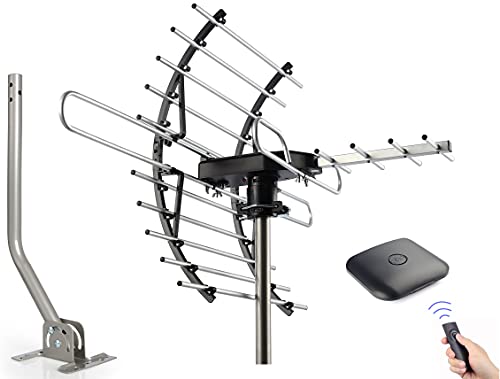
PIBIDI Amplified TV Antenna Attic/Outdoor
Arrasolt Melas 5000+ Miles Digital HD Antenna
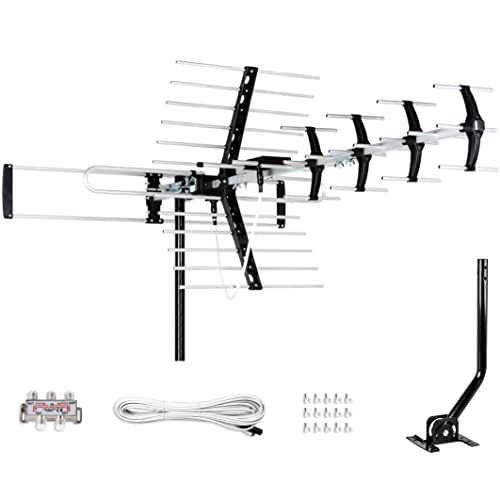
Five Star Outdoor HDTV Antenna 200 Mile Range
The Strengths Of Each Pick
The Merpersom antenna earns its spot by playing well in mixed environments: an RV weekend, a basement rec room, or an above-garage TV that the family watches during cookouts. The included 38-foot coax run means you can route the cable up a wall, across a beam, or out a window without needing to splice extensions right away.
For a household that’s not sure where the signal will land best, that length gives real flexibility to experiment with mounting height. In our view, it’s the most “figure-it-out-as-you-go” option in this lineup.
What Makes Sense
- 38-foot coax cable reaches most indoor-to-outdoor mounting spots without extra parts
- Pulls VHF (Very High Frequency, channels 2-13) and UHF (Ultra High Frequency, channels 14-51) bands for major network coverage
- Built-in Smart IC chip filters cell and FM interference, helpful in dense neighborhoods
- Lightweight build suits renters, RV owners, and campers
Things To Consider
- The very high claimed range is aspirational; real-world reception depends on tower distance and terrain
- Indoor-only mounting locations won’t pull fringe signals as well as a roof install
Who It Suits Best
Renters, RV owners, and casual viewers in suburban areas within roughly 30 miles of broadcast towers.
Skip It When
You live 50-plus miles from towers or run four TVs at once, where the Susbrothe 6000+ Miles Range Digital TV Antenna handles simultaneous feeds more gracefully.
The Susbrothe option targets the same general “free local channels” promise as the Merpersom model, but pairs it with a higher claimed range figure. In practice, that number only matters if your household is genuinely on the edge of coverage, and that’s where an amplifier and a generous cable run earn their keep.
It works quietly in apartments and small homes where running cable through walls feels like overkill. For a single-TV setup near a metropolitan area, it’s a low-fuss choice.
Well-Handled Touches
- Easy, adhesive-mount style install that won’t mark walls
- Handles the standard VHF and UHF broadcast bands
- Compatible with most set-top boxes and tuner-equipped smart TVs
Points To Note
- Range claims outpace physics for real reception at long distances
- Performance drops noticeably behind concrete, foil-backed insulation, or stucco
- Adhesive pads may need replacement in humid kitchens or bathrooms
Made For
Urban and suburban viewers with a single TV, within roughly 25 miles of broadcast towers, who want a no-drill install.
Look Elsewhere When
You need a true outdoor-rated housing with motorized aiming, where the PBD Amplified Outdoor TV Antenna 360° Rotation is the stronger fit.
The first true outdoor entry in this list, the PBD amplified model brings a wireless remote that rotates the antenna 360 degrees from your living room. That single feature reshapes the install: instead of climbing onto the roof with a wrench every time you want to chase a different tower, you click a button.
Compared with the Susbrothe 6000+ Miles Range Digital TV Antenna, this one is a different class of gear, built to mount on a roof, eave, or pole and handle real weather. The built-in amplifier (a signal-boosting component that strengthens weak incoming broadcasts) helps pull in stations that flat indoor panels struggle to reach.
A Strong Showing
- Wireless remote rotates the antenna, no second climb required
- Built-in low-noise amplifier improves fringe-signal clarity
- Supports 4K and 1080p broadcasts from compatible stations
- Sturdy housing rated for outdoor mounting in wind and rain
Worth Noting
- Requires a power outlet at the antenna location for the motor and amplifier
- Rotation motor introduces one more part that can wear out over years of use
Right Fit For
Suburban and semi-rural households who want roof-level reception and the flexibility to retune direction from indoors.
Consider Something Else When
You want an extra-long factory cable, where the PBD Amplified Outdoor TV Antenna 59 ft RG6 ships with more reach out of the box.
Step up from the standard PBD outdoor antenna and you land here: same motorized 360° rotation, same weather-ready housing, but with a 59-foot RG6 cable (a shielded coaxial cable rated for outdoor runs with lower signal loss than thinner RG59). That extra length, and the upgraded cable spec, matters when the antenna sits at one end of a long ranch-style home and the TV sits at the other.
You also avoid the signal degradation that comes from chaining two cheaper cables together. RG6 holds up better across long outdoor runs, which is a quiet but real upgrade.
The Value In It
- 59-foot RG6 cable handles long runs from roof to far wall
- Lower signal loss than thinner RG59 over equivalent distances
- Remote-controlled rotation paired with built-in amplifier
- Supports multiple TVs when paired with a splitter
Trade Offs
- Longer cable can be harder to tuck neatly along trim
- Motor and amplifier still require nearby power at the mast
Best Suited To
Homeowners with sprawling layouts, multi-TV setups, or detached garages where the antenna needs to feed entertainment far from the mounting point.
A Better Fit Elsewhere
You only watch one TV in a small home, where the PBD Amplified Outdoor TV Antenna 360° Rotation handles the job at a lighter footprint.
The PIBIDI antenna lands in a different category than its peers here: it carries an LTE filter (a component that blocks cell-tower signals which can degrade over-the-air TV reception) and Automatic Gain Control (AGC, a circuit that adjusts signal strength automatically to prevent distortion or dropout). That combination matters in suburbs where cell towers cluster near homes and bleed noise into TV broadcasts.
Attic mounting appeals to homeowners who don’t want a roof penetration, especially in HOA-controlled neighborhoods. Outside works too, giving this model real placement flexibility.
What Helps Most
- Built-in LTE filter cleans up interference from nearby cell towers
- AGC adapts amplification to signal strength, reducing pixelation
- Rotates 360° via remote for direction tuning
- Handles VHF 170-230 MHz and UHF 470-860 MHz broadcast ranges
Honest Caveats
- Attic mounting reduces signal versus rooftop exposure by a real margin
- Aluminum foil-backed insulation or radiant barriers block reception entirely
- Slightly more involved setup than a simple indoor panel
Who Should Grab It
HOA-restricted households, attic-conversion spaces, and viewers near cellular towers who need cleaner signal isolation.
Reach For A Different Pick When
You want the longest factory cable or multi-TV splitting, where the Five Star Outdoor HDTV Antenna 200 Mile Range handles whole-home runs more directly.
Arrasolt Melas makes a clear pitch: wide frequency coverage, easy indoor-or-outdoor mounting, and zero monthly fees. For suburban households that sit within reliable broadcast range, that’s exactly the right amount of ambition. The build leans simple, and that’s part of the appeal.
Where the PBD models bring motorized rotation and PIBIDI brings LTE filtering, this one focuses on a stable, no-fuss signal path. It’s the kind of antenna you mount once and forget.
What It Does Well
- Covers both major broadcast bands for network and local access channels
- Lightweight enough for window, wall, or covered outdoor mounting
- No recurring fees for the lifetime of the install
Minor Gripes
- No remote rotation means manual repositioning for distant towers
- Amplification is modest, so far-fringe reception remains a stretch
Perfect Match For
Suburban households within 35 miles of broadcast towers who want a stable, low-maintenance install without motorized extras.
Swap It Out When
You sit 60-plus miles from towers or split signal to several TVs, where the Five Star Outdoor HDTV Antenna 200 Mile Range pulls in fringe broadcasts more reliably.
The Five Star is the most ambitious option in this roundup: 200-mile range claims, ATSC 3.0 readiness (the next-generation broadcast standard that supports 4K HDR and improved audio), VHF and UHF coverage, and a J-mount (a standard antenna mast bracket for rooftop or eave installation) plus install kit included. It’s aimed at whole-home setups that split signal to four TVs without breaking a sweat.
Compared with the PBD Amplified Outdoor TV Antenna 59 ft RG6, this model trades remote rotation for raw pulling power and multi-TV distribution. If your goal is set it on the roof, run it once, and have every room working, that’s the brief.
Strengths Worth Knowing
- Supports up to four TVs simultaneously with included splitter hardware
- Multi-directional element array catches signals from several tower directions at once
- ATSC 3.0 ready for future broadcast format upgrades
- Includes J-mount and install kit for roof or attic mounting
- Covers VHF and UHF bands for full local channel access
Where It May Fall Short
- Larger physical footprint than compact motorized units
- Higher up-front cost than indoor-focused alternatives
- Fixed direction means initial aiming needs care
The Right Fit
Whole-home installations where one antenna feeds four TVs, especially in fringe-signal areas or where future-proofing for ATSC 3.0 matters.
Another Choice May Suit When
You only watch a single TV and want motorized flexibility, where the PBD Amplified Outdoor TV Antenna 360° Rotation keeps things simpler and more adjustable.
What Actually Matters Before Choosing an Exterior Tv Antenna
The single biggest variable is distance to broadcast towers. Free tools like the FCC’s DTV reception map let you enter a zip code and pull up exactly which channels are reachable, plus the compass heading of each tower. Without that data, even a 200-mile-rated antenna will struggle if it points the wrong way.
Signal direction also dictates whether you want a multi-directional or motorized unit. Towers clustered in one part of the sky suit a fixed multi-directional panel like the Five Star Outdoor HDTV Antenna 200 Mile Range. Towers scattered in different directions benefit from the rotating models that let you retune at the click of a remote.
For outdoor mounting, weather resistance and mounting hardware deserve more attention than marketing copy claims. Antenna elements that aren’t sealed properly corrode within a season, especially in coastal or humid climates. The PBD and Five Star options ship with proper J-mounts; cheaper indoor-outdoor hybrids sometimes expect you to bring your own.
Range Claims And Reality
“5000+ mile” or “6000+ mile” range ratings are mostly aspirational. Useful range in real-world installs tops out around 70-80 miles in flat terrain with a clear line of sight, and far less in hilly or forested areas. Treat those numbers as ceiling claims, not expected performance.
Amplifiers And Filtering
An amplifier boosts weak signals but also boosts noise. Automatic Gain Control (AGC), like the PIBIDI antenna carries, adjusts on the fly so strong local signals don’t overload the tuner. An LTE filter cleans up interference from cell towers, increasingly important as carriers densify their networks.
Cable Length And Quality
A coax run of 50+ feet in cheap RG59 cable can drop more signal than the amplifier adds. RG6 cable, like the 59-foot run on the PBD Amplified Outdoor TV Antenna 59 ft RG6, holds signal integrity across long outdoor stretches and is worth seeking out for serious installs.
Key Considerations Across These Picks
Pitfalls Shoppers Hit
The most common mistake is buying an indoor antenna for an outdoor job. Adhesive-mounted panels meant for windows aren’t weather-sealed, and moisture kills them within a season. Match the housing to the environment, and don’t trust indoor-outdoor hybrid claims without checking the seal at every joint.
A second trap is ignoring tower direction. A fixed multi-directional antenna pointed 90 degrees off from your local towers will deliver almost nothing, regardless of its range rating. Confirm your local tower headings before you mount anything permanently, especially heavy roof units where repositioning means another trip up the ladder.
Where The Extra Money Goes
Higher-tier outdoor antennas cost more for three reasons: heavier weather-resistant housings, larger multi-element arrays, and amplification that adjusts intelligently instead of just pushing volume. The Five Star Outdoor HDTV Antenna 200 Mile Range earns its position by combining all three with ATSC 3.0 readiness, so you avoid replacing the unit when broadcasters complete their next-gen rollouts.
The upgrade pays off most in fringe-signal areas, multi-TV households, and homeowners who plan to stay put for five-plus years. For short-term setups or urban addresses close to towers, a simpler unit handles the job.
Frequently Asked Questions
How far should an exterior TV antenna reach?
In real-world conditions, 40-80 miles is a reasonable expectation with a clear line of sight. Higher range ratings are aspirational and depend heavily on terrain, tower height, and antenna mounting position.
Do I need an amplifier for an outdoor antenna?
Amplifiers help in fringe-signal areas but can overload near towers. Automatic Gain Control models like the PIBIDI Amplified TV Antenna Attic/Outdoor adapt on the fly, while fixed-gain amps need more careful setup.
Can one outdoor antenna feed multiple TVs?
Yes, with a proper splitter and enough signal strength at the source. The Five Star Outdoor HDTV Antenna 200 Mile Range explicitly supports four TVs; smaller antennas may struggle past two.
Is professional installation required for exterior antennas?
Not strictly, but roof and eave mounts can be hazardous. Anyone uncomfortable with ladder work or roof penetrations benefits from a professional installer, especially for units like the PBD Amplified Outdoor TV Antenna 59 ft RG6 that require power at the mast.
What is ATSC 3.0, and does it matter?
ATSC 3.0 is the next-generation broadcast standard supporting 4K, HDR, and improved audio. Broadcasters are rolling it out gradually, and antennas like the Five Star model are ready for it. Existing 1080p broadcasts work fine on ATSC 3.0-compatible antennas too.
Closing Remarks
The right exterior antenna depends on tower distance, signal direction, and how many TVs you need to feed. Suburban households near towers do fine with a stable fixed unit, while fringe-signal or multi-TV homes get more from motorized or high-gain arrays. Match the antenna to your actual broadcast environment, and the local channels show up free, month after month.


